By NEWSCOP | INNLIVE
New Delhi’s No. 7 Race Course Road—Indian prime minister Narendra Modi’s official residence—today (Sept. 08) hosted some of the country’s most high-profile bankers, industrialists and policy makers.
Modi spent about three hours with the 40-member group, packed with cabinet ministers, key bureaucrats and bankers, corporate leaders and economists. Reserve Bank of India (RBI) governor Raghuram Rajan, Reliance Industries’ chairman Mukesh Ambani, Tata Group chairman Cyrus Mistry and State Bank of India chief Arundhati Bhattacharya were in attendance.
By FIRDAUS AHMED | INNLIVE
India's abstaining from a vote censuring Israel at the Human Rights Council on its conduct in last year's Gaza war recently raised eyebrows. The ostensible reason for abstaining according to India's spokesperson was mention of the International Criminal Court - to which India is not a party - in the resolution.
By SWARNAM JOHN | INNLIVE
The above quote summarizes the essence of a modern day woman. Kristen Dalton Wolfe writes in Inspiration about the qualities of a modern day lady. A modern day woman is gracious, steadfast, a leader, promotes moral excellence, is honest, is self-aware and she thinks before she speaks.
A modern day woman is the best version of herself, draws boundaries, is temperate, hospitable, uses her words wisely and represents herself with class and dignity on social media.
By M H AHSSAN | INNLIVE
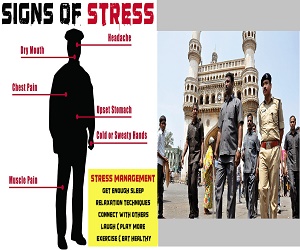
A lack sleep, irregular meals, low incomes and poor working conditions are some of the reasons attributed to higher stress levels among police personnel, according to a study conducted by INNLIVE research wing.
The study, which interviewed over 300 constables, inspectors and police personnel of Telangana and Andhra Pradesh, has outlined that inspectors have the highest level of stress followed by officers and constables.
During the study, the policemen describe their job as “unlimited and unpredictable” with “insufficient sleep hours and irregular meals” which render their lifestyle extremely exhausting and unpredictable.
The study was recently published in Indian Journal of Occupational and Environmental Medicine. It pointed out that around 90 per cent of the police personnel were under stress to due high levels of accountability and political interference, 80 per cent of them were stressed due to long and odd work hours, frequent transfers and postings, 70 per cent of them due to change in priorities, due to political shakiness, difficulty in sanctioning of leaves, role conflict between “being family person” versus “police person,” adjusting with seniors and not being able to spend time with their family.
“A major source of stress was factors such as frequent transfers, slow promotions, fear of suspension and punishment, difficulty in getting leave sanctions, insufficient staff and dis-satisfactory work distribution. Although constables were found to experience overall stress lesser than inspectors and officers, they were significantly most stressed up in the areas of environmental stress, travelling away from the organisation and work overload,” the study said.
“As many as 80 per cent of the constables felt that at their office the working conditions were very unpleasant due to the absence of indispensable facilities like proper toilets, drinking water and refreshment. They were most stressed in this area with 70 per cent of them feeling strained while commuting their workplace against 30 per cent of inspectors and 10 per cent of officers. They had to use their own conveyance like bicycles or motorcycles for official purposes for which they were not given allowances promptly,” it said.
In addition, to these findings the qualitative analysis revealed that constables felt more hassled than the inspectors and officers due to low salary structure, lack of housing and medical facilities and their inability to fulfill the demands of their families.
Moreover, there were more than 50 per cent of constables who sense their work hours as very long, they had to go for two work shifts consecutively and they were unable to spend time with their families. “They also face difficulty in adjusting with their bosses who were usually inspectors. They often feel that they were punished by their seniors without any proper inquiry and did not have any platform where they can express themselves,” the study said.
By FIRDAUS AHMED | INNLIVE
Our government and the National Security Adviser are promoting 'defensive offence' as India's Pakistan strategy. INNLIVE explains why that's not the case and that our strategy is more 'offensive-compellence' than 'defensive offence'.
A senior journalist is perplexed by India’s Pakistan strategy. He works through the options of the Modi government to try and understand what it is up to on the Pakistan front. He rules out the option of ‘defeating’ Pakistan as utterly impossible.
By MITHILESH MISHRA | INNLIVE
During a pilot project in direct benefits transfers, a fifth of the beneficiary households never received any money, and among those who did 70% got it after much delay.
Chhattisgarh has been lauded for the reforms initiated in 2004 in the public distribution system to ensure that subsidised foodgrains meant for the poor actually reached them. Over the last decade, the state’s network of food ration shops expanded to reach 85% of the population. It became the first state to implement a food security law in 2012 and was highlighted in numerous studies as a model state for the public distribution system.
By RAGINI KHANNA | INNLIVE
We have all had great teachers who have shaped our lives. Yet, we can’t pretend that India’s education system is not broken. Most of it has to do with teachers. Indian school students famously don’t ask questions in class. If you ask questions, you are a problem child. When there is rote learning to see you through examinations, why do you need to ask questions?
By SWARA BOSE | INNLIVE
The truth is that we are numb to the tragedies around us. It was the way he was dressed: the dark shorts, the red shirt and the shoes. It made countless people on my Facebook timeline say: This could have been my child.
But what if he had been wearing tattered clothes, broken slippers, or perhaps not even that? What if he had been thin and dark and malnourished? What if he had been just another poor child escaping not war but hunger and landing up on the streets of our cities? Would he even get a passing glance?