Saturday, May 02, 2009

Crown Jewels of the Nizam

By M H Ahssan

Nizam’s Jewels, valued at $ 250- $ 350 million by the Sotheby’s and Christie’s, date back to early 18th century to early 20 century. Crafted in gold and silver and embellished with enameling, the jewels are set with Colombian emeralds, diamonds from the Golconda mines, Burmese rubies and spinels, and pearls from Basra and Gulf of Mannar.

While India thought they had settled all deals with the Nizams and their 200 heirs, they are back in the news.

Osman Ali Khan nominated not his son, but grandson Mukarram Jah (born in France and had Turkish mother), to be the next (and last) titled Nizam of Hyderabad. Mukarram Jah could not take the battles over his grandfather’s wealth and escaped to Australia where in spite of having the best possible education money could buy (Harrow, Cambridge, LSE, Sandhurst), he run bulldozers, married and divorced five times, one of them being former Miss Turkey. He now lives in a two room apartment in Istanbul, Turkey.

Nizam of Hyderabad is reported to have impregnated 86 of his mistresses, siring more than 100 illegitimate children and a sea of rival claimants.

However, Jah has not been able to escape it all. He has four sons and a daughter from his five wives. The eldest of them, Azmet Jah , a cameraman in Hollywood who has worked with Steven Spielberg, Richard Attenborough, Nicolas Roeg , hopes to come back to Hyderabad.

For the Nizams of Hyderabad, Muslim rulers of fabled wealth whose authority once extended across much of southern India, the armored car that carried four steel trunks away from a Bombay bank vault last month was a punctuation mark to decades of declining fortune.

The trunks, bound for a Government strongroom in New Delhi, held a collection of jewels considered by experts to be one of the greatest ever assembled. Among them was the fabled Jacob diamond, a duck's-egg-size 162-carat stone bought by Hyderabad's ruling family in 1891. It was used for much of this century as a paperweight by Osman Ali Khan, the seventh and last Nizam to rule the royal state.

The jewels -- diamonds, rubies, emeralds and pearls, many in gold settings, some acquired from the old royal courts of France and Russia -- were making their first journey in more than 40 years. For more than half that time, they have been the focus of a struggle between the Indian Government and the heirs of the seventh Nizam, who placed the collection in the Bombay vault after his domain became part of independent India in 1947.

The seventh Nizam, who died in 1967, was known for his vast fortune and for his idiosyncratic ways, including a habit of hoarding cash that once led rats to chew their way through three million pounds in British banknotes in a palace basement. Wary of his family's profligacy, he tied up his fortune in a web of trusts. One of those held the jewelry collection, under terms that forbade its sale until after the death of his oldest son, Azam Jah Bahadur.

When that son died, in 1970, a battle opened with the Indian Government that would continue for 24 years. Finally it was settled by the Supreme Court last month. In a compromise between the heirs, who hoped to sell the jewels abroad, and the Government, which contended that the jewels should become state property with no compensation, the court allowed the Government to buy the jewels.

Setting aside a valuation of $250 million to $300 million by Sotheby's and Christie's, the international auction houses, the court set a price equivalent to $71 million.

For 200 of the heirs, including the present Nizam, Mukkaram Jah, a grandson of the seventh Nizam who spends much of his time on a 500,000-acre sheep farm in western Australia, the settlement was bittersweet. For many, the settlement -- which involves cash payouts for some, annual dividends for others -- will provide badly needed cash to pay off debts or to supplement declining incomes from the seventh Nizam's other trusts.

Indian newspapers have reported that some of the heirs have barely been scraping by on annuities from other trusts that have shrunk to the equivalent of as little as $50 a month.

Now that the jewelry has been sold, other feelings have come into play. Mohammed A. Hadi, who represented the family as secretary of the jewelry trust, said he felt some chagrin as he watched an inventory of the collection last month during the handover at the Hong Kong and Shanghai Bank in Bombay.

"Of course, after nearly 20 years, they were happy that there was some finality to the matter," Mr. Hadi said in a telephone conversation from Hyderabad in south-central India. "But it was also an emotional, a wrenching thing."

"They were naturally disappointed that they couldn't get a better price," he said. "And they were disappointed too that a big treasure that has been in the family for centuries has left for another abode."

The jewelry sale has also revived an old debate about the princely families -- the maharajahs and nawabs and nizams -- who ruled vast tracts of India for centuries until 1947. The debate has ebbed and flowed since 1970, when Prime Minister Indira Gandhi annulled agreements reached in 1947 under which the rulers of the princely states received generous state pensions as well as other privileges for ceding their domains to the new republic of India.

Some think it outrageous that Indian taxpayers are still paying out money for treasures like the Hyderabad jewels. Others argue that India owes a debt to the survivors of the princely families for having accumulated the palaces and works of art -- and the jewelry -- that now form part of the country's cultural legacy.

Even now, the issue of the Nizam's jewels seems likely to drag on, as some members of the family have threatened to contest their share of the payout. The Telegraph, a Calcutta newspaper, suggested that the spectacle of family members squabbling over the money might have amused the old Nizam. "He might be having a hearty laugh," the paper said, if he sees his descendants "constantly at each others' throats to salvage what they can from the spoils of his dead empire."

Now that it has the jewels, the Indian Government has promised to put them on display, perhaps at the national museum in New Delhi, perhaps in one of the five royal palaces in Hyderabad, several of which were opened to the public by the old Nizam's trustees for the first time last fall.

For the time being, the stones are back in a vault, this time in the sandstone fortress that is headquarters for the Reserve Bank of India.

Mukkaram Jah - grandson of the last Nizam

By M H Ahssan

Mukkaram Jah the grandson of the seventh and last Nizam Osman Ali Khan is in the city for a while.On his last visit to Hyderabd. he has celebrated his Birthday here while his son made his first public appearance in the city. Mukkaram Jah, 68, has been moving in and out of western Australia for 21 years. Jah, who has married five times,had moved to Turkey after the death of his Australian wife and mother of his two sons, Helen Simmons, in 1989

It is said that 73- year -Old Mukkaram Jah, grandson of a man who was once one of the world's wealthiest men, lost control over his west Perth mansion due to a financial crisis. He also reportedly lost control over a sprawling 202,000 hectares Murchison sheep station for the same reason. The value of the property went down further as it became subject to native title claims by local aborigines.

Jah is reported to be the owner of seven palaces in India and has assets worth hundreds of million dollars, most of which are caught up in numerous legal battles being fought by him with other Nizam descendants and the Indian government.

He moved to Australia while fighting court battles for the Nizam's jewellery collection.

After a series of legal wrangles, the Indian government took over the ownership of the massive collection after paying $ 47 million to the Nizam's heirs in 1995. But the amount has become a subject of more legal suits amongst the direct and indirect descendants of the Nizam, whose forefathers had ruled a large region of present day Andhra Pradesh.

He now lives in Turkey with his fifth wife, Princess Orchedi.

The Nizam's family had ruled Hyderabad since the early 18th century, and the Nizam was the only Maharajah in British India who enjoyed the title Exalted Highness - a reward for his generous £25m contribution to the British exchequer during the first world war.

This family was closely linked with the Moghul rulers of Delhi. They founded their rule in 1712. The state was one of the largest and the wealthiest state in all of India. Nazim Mahbub Ali Khan owned the famous 162 carat Jacob diamond. From about 1900 to the mid 1960's the Nizam of Hyderabad was reported by many as being the richest man in the world. In the 1930's the Nizam was said to have 100 million (GBP) worth of gold and silver and a further 400 million (GBP) worth of jewels. Despite this immense wealth the Nizam was not one to flaunt his wealth and he wore inexpensive clothes. On the formation of the Indian Union the Nizam chose to remain independent.

Eventually his state of Hyderabad was annexed to the Indian union. The wealth of the family has diminished due to the thousands of people who claim to be members of the family.

THE SEVEN NIZAM'S OF HYDERABAD

By M H Ahssan

In 1724 Nizam-ul-Mulk Asif Jah I founded the Asif Jahi Dynasty and seven generations of the family ruled the Deccan for 224 years up to 1948. During this period several buildings of archaeological and public importance were built. Notable among them are: Purani Haveli, Chow Mahalla Palace, Osmania University, Jubilee Hall, Assembly Building, Asifia Library, Osmania Hospital, High Court, and all the buildings in the Public Garden.

I Nizam-ul-Mulk 1724 - 1748
II Nizam Ali Khan 1762 - 1803
III Sikander Jah 1803 - 1829
IV Nasir-ud-Dowla 1829 - 1857
V Afzal-ud-Dowla 1857 - 1869
VI Mahboob Ali Pahsa 1869 - 1911
VII Mir Osman Ali Khan 1911 - 1948

The origins of the Asif Jahi dynasty can be traced to Chin Qalich Khan who was the grandfather of the first Nizam and the commander of the Mughal army during Aurangzeb’s reign. Chin Qalich Khan led the attack of the Mughal army into the Deccan under his Emperor’s ambitious plans of expanding the Mughal empire. During Aurangzeb’s last siege of Golconda in 1687,

Chin Qalich Khan was wounded. He died in Atapur village near Himayath Sagar. Chin Qalich Khan’s son, Nawab Ghaziuddin Khan, married the daughter of Sadullah Khan, Prime Minister of Aurangzeb. A son was born, and the Emperor named him Mir Qumaruddin. At the age of six, Mir Qumaruddin accompanied his father to the Mughal court. Aurangzeb awarded him a mansab, and said to his father, "The star of destiny shines on the forehead of your son". Mir Qumaruddin displayed considerable skill as a warrior and at the age of nineteen, the Emperor bestowed on him the title "Chin Fateh Khan". At 26, he was appointed Commander in Chief and Viceroy, first at Bijapur, then Malwa and later of the Deccan.

Subsequently, the Mughal empire declined. There was much confusion after the death of Aurangzeb, and Mir Qumaruddin established his position as Viceroy Farukh Siar who was the Mughal Emperor for a brief tenure conferred on Mir Qumaruddin the title Fateh Jung. He thus became the first Nizam. A subsequent Emperor, Muhammad Shah bestowed on him the title Asif Jah. The dynasty of the Nizam's of Hyderabad thus came to be known as the Asif Jahi Dynasty.

Unrest and claims to the throne continued after the death of Aurangzeb, and amidst the general confusion, Asif Jah had little difficulty in asserting his independence from the weak occupants of the Delhi throne. At that time, Asif Jah was the Sudedar of Malwa. However, his independence was the cause of much jealousy, and the Delhi court secretly instructed Mubrez Khan, the Subedar of the Deccan, to oppose him. A battle was fought at Shakar-Khelda in the district of Berer in 1724, where Mubrez Khan was defeated and killed. This battle established Asif Jah's supremacy in the Deccan. After gaining independence, Asif Jah came to be known as Nizam-ul-Mulk. He first set up his capital at Auragabad but later moved to Hyderabad, which became the capital of the Asif Jahi dynasty.

Nizam-ul-Mulk's greatest achievement was the foundation of the Hyderabad Dominion. He attained his object by waging a struggle against the Marhattas and by the policy of non-involvement in the rivalry for power between the British and the French. His policy has been justified by later events as Hyderabad state survived right through the period of British rule up to the time of Indian independence.

Asif Jah ruled wisely and established an independent state in the Deccan. He was one of the ablest statesmen. However, his death at Burhanpur on 21st May 1748 at the age of 78, was followed by a struggle for the throne. By this time, foreign powers were spreading their tentacles. Asif Jah's second son Nasir Jung was supported by the British whereas Muzafar Jung, grandson of Asif Jah, was supported by the French. Nasir Jung succeeded; but after a brief rule he was slain in 1750 in an encounter with the French troops at Arcot. Thereupon, Muzafar Jung ascended the throne. In the following year he was murdered and his son Salabath Jung was put on the throne. In 1762 Salabeth Jung was dethroned by his brother Nizam Ali Khan, and confined at Bidar where he died in 1793.

Hence, Nasir Jung, Muzafar Jung and Salabath Jung, who were contestants for the sovereignty of the Deccan in the short span of thirteen years between the death of Asif Jah and accession of Nizam Ali Khan, have not been historically recognised as reigning Nizams. If they had been, Nizam Ali Khan would have been known as the fifth Nizam and not the second.

Nizam Ali Khan ascended the throne in 1763 and he ruled Hyderabad for almost forty years. This was one of the eventful periods in the history of India. Foremost among competitors for supremacy in the Deccan were the Marhattas and it was during this period that the famous French adventurer Monsieur Raymond was employed by Nizam Ali Khan.

Nizam Ali Khan died in August 1803 at the age of 72 years after a long and strenuous reign.

The succession of Sikandar Jah as Nizam was undisputed and he appointed Mir Alam as his Prime Minister. With the accession to the throne by Sikander Jah and end of war with the Marhattas, there commenced an entirely new era for Hyderabad. Unfortunately in 1808 the able Minister Mir Alam died and it was he who was responsible for maintaining good relations wit the British. In 1809, Mir Alam’s son Munir-ul-Mulk was appointed as Minister.

Sikander Jah died in May 1829 at the age of 62 after reigning for almost 26 years. Secunderbad was named after him. Sikander Jah was succeeded by his eldest son Nasir-ud-Dowla. It was during his reign that Salar Jung was appointed as the Minister in 1853. Salar Jung guided the affairs of the Deccan with great wisdom and introduced several reforms to improve the finances of the Dominion.

On 17 May 1857 Nasir-ud-Daula died and his son Afzal-ud-Daula became the fifth Nizam. This was the first time the first war of Indian Independence was fought in the North and there was general disorder in the Deccan.

After a reign of twelve years, Afzal-ud-Daula expired on 26 February 1869 at the young age of forty three years, leaving behind the infant prince Mir Mahboob Ali Khan who was hardly three years old.

Mir Mahboob Ali Khan, who was born on 18 August 1866, was the only son of Afzal-ud-Dowla. He was installed on the masnad by the British Resident and Sir Salar Jung, who also acted as the co-regent. Salar Jung died in 1883 and a provisional council, consisting of five members, with Mahboob Ali Khan as president and Mir Laiq Ali Khan, son of Salar Jung, as secretary was appointed for administrative purposes.

Special attention was paid to the education of Mahboob Ali Khan. With the concurrence of Salar Jung, Capt. John Clerk was appointed as his tutor. However, the personality of Salar Jung had a great influence on his life. Brought up under the guidance of this great statesman, Mahboob Ali Khan grew in his later years to be one of the greatest rulers of his time. He was a respected and dignified personality and was popularly know as ‘Mahboob Ali Pasha’. He died on Tuesday 31 August 1911.

Mir Osman Ali Khan, the seventh and the last Nizam of Hyderabad ruled for 37 years (1911 - 1948). His dominion was lager than England and Scotland put together, with an area of 86,000 Sq. miles.

The seventh Nizam led a very simple life, yet he was one of the richest men in the world. He donated generously to every cause in India as well as abroad irrespective of caste and religion. If it was the Muslim theological school at Deoband which received financial help, it was also the privilege of the Benaras Hindu University. His list of donations included Rabindranth Tagore’s Shantiniketan and several other institutions including hospitals, schools, for famine relief, etc. The golden temple in Amritsar also enjoyed an annual donation.

The Nizam’s rule saw the growth of Hyderabad economically and culturally. Electricity, railways, roads and airways developed. Huge reservoirs and irrigation projects such as the Tungabhadra, and Nizamsagar were completed. The early work on Nagarjunasagar was undertaken. The Osmania University, Colleges and Schools were founded throughout the state. Nearly all the public buildings currently in such as the Osmania General Hospital, High Court, Central State Library, Assembly Hall, Jubilee Hall and other buildings in the Public Garden were built during Osman Ali Khan’s reign.

Soon after India gained independence in 1947, all princely states were invited to join the Republic. Nizam VII was reluctant to do so; but in 1948, after the Police Action, his state was merged into the Indian Union. Mir Osman Ali Khan, the last Nizam, died on Friday 24 February 1967. It was the end of the princely era.

HYDERABADI NIZAM AND HIS PRIDE

Compiled by M H Ahssan
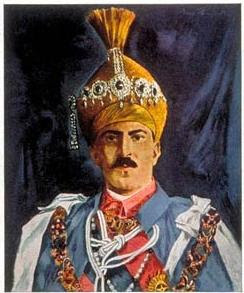
India has no native state so rich, potent and extensive as Hyderabad which is about the size of the United Kingdom and there last week the Royal Family of the Asatia Dynasty celebrated the Silver Jubilee of "The Richest Man in the World," Lieut. General His Exalted Highness Sir Mir Osman Ali Khan, the Nizam of Hyderabad & Berar.

Because the scheduled Coronation Durbar next winter of British King & Emperor George VI has had to be canceled by His Majesty, there is no immediate prospect for the world to see such another Indian spectacle of pomp and power as that of the Jubilee Durbar which began in Hyderabad with warlike display of 10,000 Hyderabad troops last week and will close Feb. 26 when the Nizam prays in the public gardens of the Great Mosque, entertains the eminent Indian theologians of his Dominions, and throws open the characteristic and important Hyderabad Departmental Progress Exposition.

Some Indian sovereigns are lecherous, champagne-quaffing wastrels with a taste for French women and English horses which they spectacularly gratify from Monte Carlo to Epsom Downs and Hollywood, but decidedly the Nizam is different, and by an honored Hyderabad tradition no Nizam has ever left India no matter how good a reason might exist for doing so. Ever since Hyderabad stood aloof from the great Indian Mutiny of 1857, its Royal Family have been accorded by British Royalty special honors and the Nizam now has the official status of "Faithful Ally." This gracefully implies that his exalted highness is not so much the inferior as the colleague of His Majesty the Emperor of India — and, during the World War, the dry, grave "Richest Man in the World" contributed to Britain some $100,000,000 cash plus untold supplies and Hyderabad army units.

Safety First is the policy of the Richest Man, and in Hyderabad this continued to mean last week the flourishing reign of probably the ablest native government in India, with its key statesman Finance Minister the Nawab Sir Akbar Nazarally Hydari. During the cycle of Depression his famed "Three-Year Budgets'' have always balanced with a surplus and Hyderabad taxes have not been raised. Sir Akbar's system is to have an annual accounting of each Government Department provisionally, but to carry forward to a so-called "Grand Accounting" only every three years. He will close the books of Hyderabad's present financial triennium Oct. 5, 1937, including such comparatively recent items as $65,000 to the Memorial Fund for King George V, $25.000 for Hyderabad broadcasting equipment, $12,000 to victims of the Quetta earthquake and an additional $9,000 to the academy named after Indian Poet Sir Rabindranath Tagore. Because his exalted Highness the Nizam is a Mohammedan (a descendant of the last Mogul Viceroy), while about 90% of his 15,000,000 subjects are Hindus, it was discreet in 1902 to appoint a Hindu Prime Minister, the Maharaja Sir Kishen Pershad Bahadur who was still nourishing last week. Living nowadays in semiretirement, Hindu Sir Kishen leaves the business of running Hyderabad largely to Mohammedan Sir Akbar Hydari, several of whose adroit coups have jolted Islam as well as the British Raj.

Holy Coup, Most news stories hung on the Richest Man are chiefly chatter about how careful His Exalted Highness is with his pennies — whereas $5,000 is his approximate daily income, his jewels have an estimated value of $150,000,000, he reputedly has salted down $250,000,000 in gold bars and his capital totals some $1,400,000,000, not to mention the fabled "Mines of Golconda." In English poesy, these disgorge a never-ending stream of diamonds. They lie immediately west of the city of Hyderabad, India's fourth largest metropolis (pop. 400,000). frowned upon by the beet-domed tombs of the Royal Family (see cut, p. 22) about five miles out in the suburbs. Poesy aside, the Mines of Golconda have yielded diamonds in only trifling quantity and were exhausted long ago. What fooled early English travelers was the fact that Golconda was long one of India's chief centres of diamond cutting, strongly fortified to protect these precious stones: "The Riches of Golconda."

The Nizam of Hyderabad is supposed to have once refused to pay 6¢ for a dab of ice cream, rebuking the vendor for asking this "high price." In Sunday supplements he is said to have his worn clothing cut down to fit the next smaller member of the Royal Family, and so on. In fact the World's Richest Man is just about as tight & loose with his money as the poorer John D. Rockefellers. One of his old Hyderabad customs is never to receive one of his subjects, no matter how poor, unless the subject brings a cash present for His Exalted Highness.

To the Richest Man more money, gold or jewels would have no overwhelming appeal, but as a Mohammedan he could aspire to mix the blood of his descendants with that of descendants of the True Prophet and in 1931 a coup of this holy character was brought off by Sir Akbar Hydari.

Up to the fall of the Turkish Empire its ruler was both Sultan and Caliph or "pope" of Islam. On the French Riviera, thoroughly deposed so far as Turkey was concerned, lived and still lives "His Imperial Majesty the Caliph Abdul Medjid II" and a ripe 17 was his beauteous daughter Princess Dur-e-Shawar in 1931. Beauteous too was his niece the Sultana Nilofar Hanim, great-granddaughter of Turkish Sultan Murad V. Best of all, the Caliph had no son and his hoary beard was that of a Patriarch unlikely to become again a father. At the death of this pope of Islam, therefore, pious believers would look upon the offspring of his daughter perhaps not as an orthodox and regular Caliph but certainly with utmost reverence in the absence of any other Caliph. Obviously the two pretty girls were a prime match for the two sons of the Nizam of Hyderabad and off these princes—Azam Jah and Moazam Jah—were packed to Europe—the first royal Hyderabad males ever to marry outside India.

Nowadays there is always plenty of money for His Imperial Majesty the Caliph Abdul Medjid II and almost any sunny day he may be seen strolling with a mien of great dignity along the beach near Nice, attired in swimming trunks only and carrying a large parasol. "I live apart from worldly vanities here in Nice," recently observed the Caliph, whose favorite reading is Anatole France. "I read, I play the piano, I paint. Nice is perhaps the only foreign city which is popular with the Turkish people. You will recall that in the 16th-Century Wars against Charles V of Spain, the people of Nice witnessed the imposing spectacle of 150 Turkish ships of war sailing to the aid of 40 galleys of the French King François 1er"

Two years after the Crown Princess of Hyderabad's marriage, she returned to Nice to give birth to her chubby son the Nawab Mukaramja in the holy presence of the Caliph her father. Now back in Hyderabad, she has devoted herself to Indian female uplift movements and this week the Crown Princess marshaled the Hyderabad Girl Guides in the Jubilee Durbar. Unlike their husbands, who follow their father's example in dress, the Caliph's girls dress as Indian ladies do.

26-Year-Old Rolls. Attempts by correspondents to get advance stories on the Nizam's Jubilee drove them frantic as His Exalted Highness kept paring down his Durbar budget. Elephants cost a good deal more as a means of royal transportation than Rolls-Royce cars and while a lesser Indian potentate simply must ride out with elephants galore, one elephant has always seemed enough to the Nizam. Of late he has given careful thought to whether the World's Richest Man need ride an elephant at all. Suddenly last week the Hyderabad State Railway Shops received rush orders to spend not a penny more than $500 putting streamlined fenders on a Rolls-Royce which gives only eight miles to the gallon and so has been run but 300 miles by His Exalted Highness during its career of 26 years in Hyderabad. While putting on the streamlined fenders, Hyderabad artisans were instructed to build the centre of the body up much higher last week into a sort of throne topped by a gilt dome. In this way the Rolls was made practically as good for a parade as an elephant & howdah.

Up to the last few days before the Jubilee, citizens of Hyderabad had obeyed the Nizam's injunction not to waste money on decorations, but at the last minute strings of electric lights were invested in by many householders. Taxi drivers contributed to the excitement by going on strike. In the crush of arriving guests were the Empire's No. 1 Mixed Couple: creamy onetime Mrs. Thomas Loel Guinness, formerly of the "British Beerage" and her present burnt-almond husband, the Prince Aly Shah Khan, son & heir of the famed Aga Khan.

With Hyderabad citizens kneeling at the roadsides in prayer this week the Jubilee began with the 26-year-old Rolls-Royce followed by two 30-year-old Rolls-Royces gliding through the streets escorted by four regiments of infantry, a detachment of native cavalry gaily caparisoned, two batteries of artillery, a regiment of Arabs and the personal bodyguard of His Exalted Highness who employs for this purpose Sidis from Africa. Instead of cheering the populace prayed and the Nizam of Hyderabad on his Rolls Throne wore not a single ornament or diadem and was not in uniform. As on other days (see cut, p. 20) His Exalted Highness wore an ordinary suit and simple turban.

On the Mohammedan theory that "all are equal before Allah in prayer," the World's Richest Man prostrated himself with his subjects at the Great Mosque and everyone prayed. Poems were recited and the venerable Hindu Premier read an address hailing his Mohammedan Monarch as "today the sole relic of Mogul greatness in India."

Uncorked amid huzzahs was an appointment signed by His Majesty Edward VIII, and saved up for last week's Jubilee Durbar, creating Hyderabad's Crown Prince Azam Jah additionally Prince of Berar. Thus officially ended was the long dispute over Berar which was almost taken away from Hyderabad by domineering Viceroy Lord Curzon. Berar is about the size of Switzerland, immensely valuable because its peculiar soil produces the finest cotton which can be grown in India.

The State of Hyderabad, "Heart of the Indian Peninsula," occupies the centre of the continental lobe. Unusually fertile and desert free, it is dotted with artificial lakes and storage reservoirs, has no sea-coast—a grave disadvantage—but is well watered by a system of rivers on which float many a quaint coracle. The district drains eastward into the Bay of Bengal.

The Residency. No royal and ruling Indian, not even His Exalted Highness, ever escapes a British Residency, an outpost of London which makes him feel the more or less iron hand of Britain in a less or more velvet glove. In his early days as Hyderabad's ruler the present Nizam dismissed the Diwan or acting cabinet and directed affairs as his own Prime Minister for some years with such vigor that "The Residency" was often rumored pressing for his abdication. Came the War. The Nizam's $100,000,000 gift to Britain squared many things, and Sir Akbar Hydari now manages to square the rest. However, the Richest Man considered his Royal Family not too exalted last week to accept the hospitality of British Duncan George Mackenzie, in the white-columned palace of the Raj.

Constitutional Crisis. Today Indians, royal and otherwise, are just beginning under a new Constitution to edge up to the head of India's table for the first time since the Empire was set up. Among ways of wrecking this Constitution would be for the ruling Indian potentates to refuse to sign the Act of Accession intended to bring their States into the new All-India Federation. Last year the Maharaja of Patiala, longtime chairman of the Chamber of Princes, re-signed rather than continue his role of being more or less Britain's whip over his fellow Princes. In the secrecy of their courts and councils last week India's ruling Princes tensely and suspiciously watched the Indian elections. Strongest figure on the princely stage was the Nizam of Hyderabad's trusty Sir Akbar Hydari, firm demanding of the British Raj virtual amendment of the new Constitution by insertion in the Act of Accession, presenting for the signature of His Exalted Highness and other native rulers, such ultrasafe clauses as: "Nothing in this instrument affects the continuance of my Sovereignty in and over this State."

In Hyderabad the native government is real, it is earnest, and the life of His Exalted Highness is much involved with projects of irrigation, soil conservation, the anxieties of how much in the way cotton piece goods is imported from Japan rather than England, modernization of the Hyderabad State Railways and the still somewhat novel issues raised by electricity. The words on a modernistic building of which Hyderabad is proud are not in native characters but read "POWER STATION", and the Nizam has promised communal radio sets to every town and village.

The cash Silver Jubilee gifts to the Nizam of Hyderabad, by his subjects were expected this week to total at least $1,000,000.

Jagtial - A city of joy & happiness

By M H Ahssan

Jagtial (also known as Jagityal) is one of the biggest towns and mandal headquarters in Karimnagar district, Andhra Pradesh, India. Jagtial is located at 18°48′N 78°56′E / 18.8°N 78.93°E / 18.8; 78.93. It has an average elevation of 264 metres (866 feet). As of 2001[update] India census, Jagtial had a population of 89,438. Males constitute 48% of the population and females 52%. Jagtial has an average literacy rate of 63%, higher than the national average of 59.5%: male literacy is 75%, and female literacy is 51%. In Jagtial, 12% of the population is under 6 years of age.
The economy of Jagtial is purely based on the commercial and retail consumer business. The town is known as a shopping center for the surrounding villages and towns. Majority of the trading community conduct business related to groceries, clothes, iron and hardware. Farmers from the surrounding villages sell their vegetables in the Jagtial market. Lately starting from 1980's Jagtial is slowly becoming a hub for healthcare. It now boasts no of doctors who can treat serious health issues.

The Cleanest city in the State. The population of Jagtial is around 200,000. Indian postal code 505327. This is an assembly constituency of Andhra Pradesh State. Telugu, Urdu, Hindi, English are widely used languages in Jagtial.

A big Mosque is located near the historical Fort called Jama Masjid. It was constructed in when the town Jagtial was found and 18th century it was renovated . The architecture of the mosque indicate the Nizam shahi era.

Jagtial is surrounded by many Hindu religious pilgrimages such as Vemulawada (35 miles), Dharmapuri (20 miles), Kondagattu (14 miles). Some historical sites such as Polasa (Kakatiya inscriptions from 14th century mention this village as Poulasteswarapuramu) are neighbouring villages to this town. Jagtial is the centre of education for its neighbouring villages. Anthargam village 2KM from Jagityal well known for political leaders. First Member of the Parliament for Karimnagar Constituency was represented by Maknoor SriRanga Rao. The village had historical significance of producing leaders like Maknoor Dharma Rao Ex-MLA, Maknoor Jithander Rao Jagtial Council member, Rajesham Goud Ex-MLA and Minister and ZP chairman, Suddala Devaiaha MLA.

Jagtial is also known for the movement of Agricultural workers from which the Naxalism had born. Jagtial has a fort which was built in the period of Moghal dynasty. Then the village 'Polasa' was a known place for elite people, experts in Sanskrit and related research.

Polasa contains a very beautiful and peaceful temple known as "Poulastheshwaralayam". It is the trust and belief of the people that you will get immense peace and heart with full of joy when you enter in to the Temple. One saying is there that if you ask for some thing, you will definitely get it.

The government created a temporary housing in the outskirts of Jagtial for the engineers involved with Sriram Sagar dam. This place is known as Dharoor Camp. This is a key administration place for monitoring the distribution of River Godavari Waters for the northern Telangana region. Kakatiya canal carries water from Sri Ram Sagar project to Khamma district and is 5 km from Jagtial.

SKNR Degree college is the only college in the city which is worth to mention and many politicians were created in this Institute. Old High School is the Oldest school in the Town. Jambigadde is the place where dasara festival is celebrated grandly. Narakasura vadha will be performed at jambigadde and thousands of people will come to jambigadde on the day of dasara to see the venugopala swamy pooja and Narakasura vadha.

Many reputed schools in Karimnagar district are located in Jagtial like GOUTHAMA. Which made it an education center for most surrounding villages.One of the best residential schools in Karimnagar Dist located in Jagtial. Gouthama got 3 consecutive state ranks on par with any corpporate institues in A.P

The fort which is located in Jagtial near to Jama Masjid was built by two French engineers, Name Jack & Tal, so the name of the town Jagtial was came by the two names of the French engineers. The fort was built by the Moghal Emperor, the king's name was Ibrahim Dhamsa. The aerial view of the fort is like a star, inside the fort there are cannons to defend the enemies, on the cannons a name is written in Urdu, Mohammed Khasim. The history of Jagtial is script on a board which is near to the principal office of SKNR Degree college. There are three Degree colleges in this town one is SKNR degree college, second one is degree college for woman in this Jr college is also situated, and third degree college is located at Vani nagar it is a private college.A new DIET college was found on the way to Karimnagar.

'For schooling Jagtial was first place in Districr as RADIANT HIGH SCHOOL Was only one and only one school in jagtial which was only in race for past 20 year.',There was another three schools which was also in race but they did not succeeded in the race,One is Public School at present shanti Jr college is there in that primises,second one is Fatima primary school it was located opposite to Standard steel furniture workshop in the street of Gunj, and the Third was Little flowers it was located in Gunj street. There is a historical sign located in the heart of the town named clock tower. It was built in earlier of 18th century by Nizam's minister khasim razvi. The tower has four big clock on four sides of it. the people can know the time by watching it and also by its Bells. - There is Engineering college Dr.VRK it is a Muslim minority college, it is situated 4 km distance main road to Karimnagar.

Raikal which is 22 km from jagtial. Thrikutal temple is constructed in kakatiya period. kotilingalu(capital city of kakatiyas prior to warangal) is 20 miles away from here.

T.Jeevan Reddy gaaru is an MLA from Jagtial town. A prominent person, presently Roads and Buildings minister for the state Transportation

With the opening of Jagtial–Karimnagar new BG railway line (nearly 48 km), Jagtial got a place on the Indian railway network. A daily passenger train from Jagtial to Sirpur Kaghaznagar is being run from 26 December 2007. When the Jagtial–Nizamabad (nearly 92 km) new railway line is completed, the Peddapalli-Karimnagar-Jagital-Nizamabad railway line will connect two major south-north trunk railway lines (Kazipet-Nagpur and Secunderabad-Purna-Akola-Khandwa railway lines). More train services can be expected through Jagital after completion of the railway line to Nizamabad.

Buses form another mode of transportation. Autos are commonly used in the town. Railway track between Karimnagar-Jagitial was opened for traffic in December, 2007.

New colony named Housing board established in Jagtial. In Daroor Camp, Andhrapradesh Housing board constructed nearly 3000 houses which includes LIG, MIG and HIG. It served to all sectors and people from all areas were very much interested to purchase a house at low cost. Now Government is thinking to shift all government offices to Dharoor camp. This may be expected by end of 2008.

World Deaf Day – It's time to share the concerns!

By Jayasharma V S

This year I will actively take part in the World Deaf Day celebrations on September 23. Till last year, I did not have even the slightest clue that a day of this kind existed until I hit upon an interesting news item on the internet! I will tell you about this a bit later but for now let us see more about this World Deaf Day.

As the name suggests, World Deaf Day is celebrated for the deaf and by the deaf. We must understand that Deaf Day is not a day to merely extend our sympathies to the deaf but to see it as an opportunity for us to make a change in their lives. The World Deaf Day sees the largest congregation of deaf people in different parts of the world and is marked with rallies, and deaf awareness campaigns. Fun events are also conducted for the deaf. Now to the interesting news item I read on the internet.

In a novel experiment during World Deaf Day last year, the students at Valencia High School in California decided to live the life of a deaf for one full day and what better day to do this than on the World Deaf Day. From the moment they woke up on the morning of September 23, 2008 and until night these students wore signs that said "deaf" on them, wore earplugs, and used only sign language to talk. For me the experiment was not an ordinary one! I am sure the students must have felt it the same way. I saw this experiment as not only a fun way to learn things but an exhilarating way to experience the hard world of the deaf and more than that understand and alleviate their difficulties in all possible ways.

Some facts about the deaf community in India: Health care is the need of the hour
The novel experiment by the Valencia students was an eye opener for me. I began to spend more time in finding out more and more about the life of the deaf and how I could help them. My first task was to find out some facts about the deaf community in India. There are different estimates on the population of the deaf people in India. The Association of Sign Language Interpreters (ASLI) puts the figure at between 7 and 10 million. And some other estimates put it as high as 60 million. Whatever the numbers are, the deaf community needs our unified support. And to know how we could support them it is important to understand how deafness is caused. Deafness is caused by various reasons and is not limited to the popular culprits: genetics and congenital disorders. Trauma, infections, build-up of fluids or wax, atmospheric pressure changes, toxins, allergies or reactions to certain medications and therapies, and even occupational hazards could cause deafness.

As far as India goes there is a direct link between poverty and subsequently the access of proper medical care. People who are not born deaf but get affected due to other reasons stand a good chance of getting cured. However poverty deprives them of quality health care and subsequently they lose the power to hear! So, providing quality health care becomes the primary step in helping the deaf community in India. You and I could step in to do our bit here. To begin with you could help a poor child in your community with access to medical facilities. You could also take part in the awareness campaigns organized by organizations for the deaf in your area.

The language of the deaf
While the American Sign Language (ASL) is globally preferred as the language for the deaf, different sign languages are being used by the deaf community living in different countries. In India there are many dialects of sign language. From the predominantly popular Indo-Pakistani Sign Language (IPSL), to the metro-specific Delhi Sign Language, Bombay Sign Language, almost every metro has its own Sign Language. Today, the deaf community in India is reportedly working towards a single sign language.

As you might already know, the deaf people have their own special schools. Almost every state in the country has deaf education organizations that run schools to offer speech and auditory therapy, educate them and provide placements besides training teachers of the deaf. There is the popular Association of Sign Language Interpreters (ASLI) that provides the deaf community of India with quality interpreting services, quality training and placement opportunities. The National Association of the Deaf (NAD) is an organization that works towards the rights of the deaf from the Government and policy makers. From the government side, the Rehabilitation Council of India offers interpreter training, maintains a National Directory of Interpreters, and provides training to teachers.

Sign language interpretation as a profession in India
When compared to other countries, the concept of sign language interpreting as a professional service for deaf persons is yet to gain foothold in India. And to achieve this formal and effective training into sign language interpretation becomes necessary. It is heartening to see that organizations like ASLI along with government and non-government organizations are working towards this. These organizations help create awareness in the general public about the interpreters for the deaf, provide structured training and aim to bring the concept of interpreting in India in line with the UN Convention on Rights of People with Disabilities (UNCRPD) that could earn interpreting a professional status in the country.

What you could do?
Silence has its own respectable space in our lives. Sometimes silence has the power to convey our truest emotions where even the powerful words fail. I strongly feel that the World Deaf Day has much more meaning to it. I see this Day as a day to celebrate the boundless optimism of the deaf people to persist and prevail. I see this day as an opportunity for every one of us to pledge support, do our bit to the deaf community. Let this Day be the beginning of a little understanding of the fact that the lives of the deaf community should not be satirized. Secondly, let us not stop with mere sympathies and words but try to understand the needs of the deaf community and extend our support in every possible way.

A Magic Wand For Hungry Stomachs

By Sayantan Bera

NIKODAM TUTI owns a smallfarm in a village amid lush green forests, barely 50km from Ranchi, the capital of Jharkhand. His one-acre land feeds five stomachs. Until two years ago, Tuti, who belongs to a tribe named Munda, grew rice, finger millets and pulses on the nonirrigated patches, yielding barely enough to feed his family for four months. He worked half the year as a construction labourer in Mumbai to make ends meet — purchasing food grains, meeting medical emergencies and affording private schooling for his two children.

Life was a continuous struggle. Crop failure or sudden illness would mean going hungry for days. But thanks to a simple process of rice cultivation introduced by an NGO in his village, Dulli, Tuti’s half acre of paddy now yields 16 quintals of rice opposed to less than three quintals earlier. In 2007, for the first time, he even managed to sell enough to repay debts.

“I now want to lease land and buy bullocks to plough my fields,” Tuti says, full of hope. His is a lesson worth emulating for India’s paddy farmers, 70 percent of whom have no access to either irrigation or mechanised inputs.

System of Rice Intensification (SRI) — the technology that has brought him the miraculous turnaround — was developed in 1983 in Madagascar. Initially, agricultural scientists shrugged off the practice saying it sounded “too good to be true”. For long, it was hard to make farmers understand that they could double their yield using one tenth the seeds and half the water in this technique. But slowly, that is changing.

The SRI is based on the principle that the rice plant doesn’t necessarily need to be submerged in water to grow. Traditionally, a nursery bed is first prepared, the seeds are sown, and the saplings are allowed to grow for 25 days, after which they are transplanted into the main field in bunches of six to seven, scattered six inches apart. But in SRI, 8-12-day-old saplings are transplanted — individually — and spaced 10 inches apart.

Young saplings adjust easily to the soil while the distance between them allows for more nutrition, unlike the traditional system which has them competing for nutrition. Less water and more spacing between plants create an ‘aerobic condition’ that promote better plant growth. SRI uses less seeds and chemical inputs, which promotes soil biotic activities in and around plant roots, making them more resistant to pests. A liberal application of compost, and weeding with a rotating hoe that aerates the soil, improve productivity with yields of eight tons per hectare — about double the present world average and thrice the Indian average.

While a kg of rice produced traditionally consumes anywhere between 3,000 to 5,000 litres of water, implementing SRI halves the requirement. Earlier considered unworkable without irrigation, SRI is now seeing results even in areas with highly sporadic rainfall and no irrigation. Recently, it was also researched that SRI can be extrapolated for sugarcane, millet and wheat. For most of India, this should be a magic wand.

In India, rice is the main agricultural crop. As much as 23 percent of the country’s total cropped area falls under rice cultivation. Therefore, at the macro level, the potential of SRI or adopting some of its ‘process’ features is immense.

“The first advantage of SRI is that a household of five to six is assured of food security round the year from less than an acre of land,” according to D Narendranath, the Program Director of PRADAN, the NGO that has been promoting SRI in eight states of eastern and central India. He says components of the technology have worked well in areas with rains but little or no access to irrigation. This, he says, is significant because as much as 44 percent of India’s rice growing areas remains non-irrigated.

PRACTICED SUCCESSFULLY in 34 countries, the potential of SRI is getting global. In India, its outreach has been steadily gaining foothold. North India has seen SRI implemented in parts of Himachal Pradesh, Uttarakhand and Punjab. In south and central India, Karnataka, Tamil Nadu, Andhra Pradesh, Orissa, Jharkhand, West Bengal, Madhya Pradesh and Chhattisgarh have adopted it quickly. In most areas farmers have been introduced to SRI primarily through NGO initiatives. Unfortunately, apart from in Bihar and Tripura, the participation of the state governments and departments of agriculture in promoting SRI has been negligible. A common reaction has been to dismiss it has a highly labour intensive and cumbersome process of cultivation. Yet, in comparison with India, the whole of Southeast Asia, as also China, has been aggressive in practicing SRI.

The District Agricultural Officer of Ranchi, Hemangini Kumar, is all praise for the new technology that her office demonstrated among 100 farmers in 2008 through the National Food Security Mission (NFSM), the Rs 4,800-crore Central scheme that aims to increase production of rice, wheat and pulses to bridge the country’s shortfall in basic foodgrain. “Extension to more farmers will take time as there is a staff shortage,” she says. “But this is the only cost-effective way to increase yields for small and marginal farmers.”

In a paper published in the Economic and Political Weekly [February 2009], noted development economists, Jean Dréze and Angus Deaton, estimate that 79.8 percent of India’s rural population does not get the prescribed norm of 2,400 calories per person per day. The statistics from the India State Hunger Index 2008, released by the International Food Policy Research Institute (IFPRI), shows that not a single Indian state is even ‘low’ or ‘moderate’ on the index score; most states have a serious hunger problem.

Since rice is India’s principal food crop, augmenting production can, therefore, go a long way to ensure year-round food security for rural households. Increasing the area under rice cultivation and achieving higher yields with improved methods like SRI is one way this can be accomplished.